Temple & Deity
ದೇವಾಲಯ ಮತ್ತು ದೇವರು
Sri Mahalingeshwara — Hari and Hara, together
At this kshetra, Hari (Vishnu) and Hara (Shiva) are worshipped together in the sacred presence of the Ganga — known together as Harihara.
Hari and Hara, worshipped together
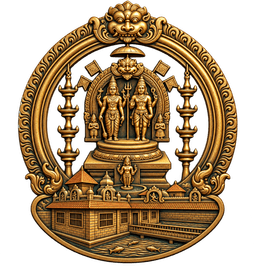
The presiding deity here is worshipped as Sri Mahalingeshwara, also known as Harihareshwara — a name affirming that Hari (Vishnu) and Hara (Shiva) are honoured together at this kshetra, in the sacred presence of the Ganga. A temple account describes this literally: Hari enshrined on one side and Hara on the other, with the Ganga's presence between them — rather than the single composite, vertically-split murti more commonly associated with Harihara temples elsewhere in India.
The precise iconographic details of this murti — beyond the general Harihara tradition described above — have not been independently verified for this page; the temple administration's own materials remain the authoritative source. The sacred geography described below draws on a temple document.
The kshetra's sacred geography
A temple account describes the Ganga-tirtha as present within the garbhagudi (sanctum) itself, with the Surya and Chandra Pushkaranis — the sun and moon tanks — lying in front of the temple, and a further tirtha well on its right-hand side. The deity's shrine stands atop a raised platform (peetha); taken together, the account presents this layout of tirthas, pushkaranis, and shrine as forming a single, unified kshetra.
The Vrindavana of Sri Varadaraja Tirtha
Beside the Harihareshwara temple stands the Vrindavana (samadhi shrine) of Sri Varadaraja Tirtha, the eighteenth pontiff of the Kumbhasi Matha, who renovated the matha here and was entombed at Kumbhasi in 1481 CE. Devotees of the Madhwa tradition visiting the temple often also offer prayers at the Vrindavana.
A living link to the Ashta Matha
Kumbhasi's temple complex is tied closely to the monastic history of the region: it was the original seat of the Kumbhasi Matha, one of the eight mathas founded by Sri Madhwacharya, before that lineage grew into the present-day Sri Sode Vadiraja Matha. The temple therefore holds significance both as a Hari-Hara shrine and as a site of Madhwa monastic heritage.